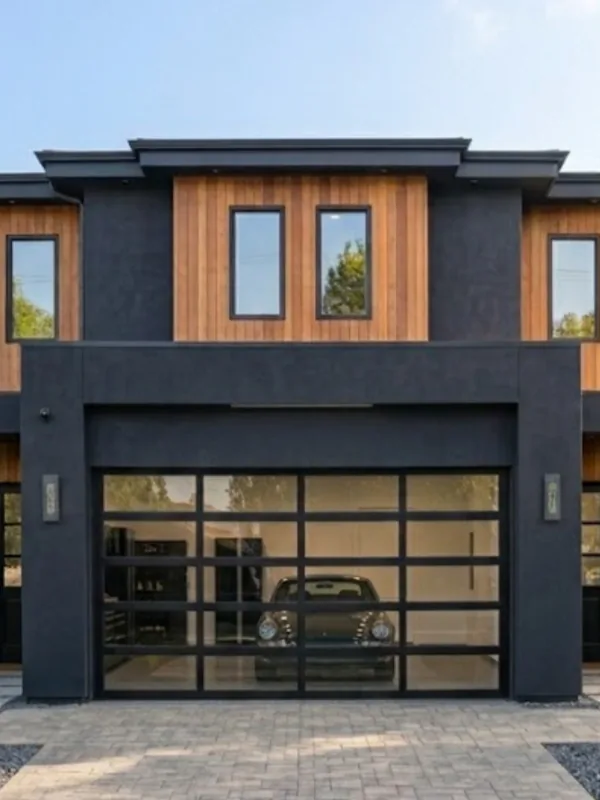
Start with the quotes
"The two proposals don't even describe the glass the same way." That sentence came from a builder trying to compare modern glass garage doors for a client. One quote listed "frosted tempered glass" and nothing else. Another said "Low-E insulated glass units" with no note about privacy. A third mentioned laminated glass but skipped the frame material. None answered the basic question: what will the door look like from inside at night, and how much heat will it actually lose through the assembled door?
Modern glass garage doors are not one product. They are a configuration. The glass type, the frame system, the size of the glass area, and the way the sections meet all change what you get. A quote that names only a glass finish is incomplete. A quote that names only a coating is also incomplete. The useful comparison starts when you put the pieces side by side in one document.
This guide is for a homeowner or builder holding two or three proposals. It is not a design essay. It is a way to read the quotes, list what matters, and ask for the missing answers without guessing.
One glass word is not a specification
WANJIA Hiseng lists clear, frosted, tinted, Low-E, laminated and insulated glass choices for framed glass garage doors and frameless mirrored garage doors. The word "frosted" on a quote does not tell you how much light passes through. It does not tell you if the frosting is etched, film, or an interlayer. It does not tell you how visible a person or a car is from the street at night. The word "Low-E" does not tell you which surface has the coating or how the door performs once the joints and hardware are included.
When you compare quotes, make a small table. Write the supplier name. Then write these four lines under each one: glass type, glass position, frame description, and what the supplier will not confirm. Leave the last line blank until you ask. Most proposals will not volunteer what they cannot confirm.
Frosted glass is not automatically opaque. It scatters light but can still show shapes and movement, especially when the inside is brighter than the outside. Mirrored glass may leave the interior visible at night when its lights are on. The only reliable way to judge is to look at an actual sample under both lighting conditions, daylight from outside and artificial light from inside after dark. A quote that does not offer a sample or a mock-up leaves too much to language.
For a more detailed look at frosted options, see frosted glass garage doors. If you are still deciding among door types, types of garage doors compares general categories. And for a broader view of glass-heavy designs, full view garage doors explains the framed approach.
The comparison worksheet
A useful buying document is a single page with one row per supplier and one column per attribute. It does not need to be complicated. The act of filling it in forces you to spot what a proposal does not say. Here is a small blank worksheet you can copy or draw by hand.
| What to compare | Supplier A | Supplier B | Supplier C |
|---|---|---|---|
| Glass type(s) offered | |||
| Glass position in frame | |||
| Frame material and finish | |||
| How privacy is described | |||
| How thermal loss is described | |||
| What sample may be viewed | |||
| What the quote does not state |
Do not invent answers. If a supplier has not answered a question, write "not stated". Then ask. A legitimate supplier will answer in writing. A vague answer after a direct question is itself information. It tells you that the person selling the door does not know or does not want to be pinned down.
Keep the worksheet in the project file. When a quote is revised, update the row. When a second supplier answers, fill the next column. The comparison becomes a record of what was promised, not what was implied.
Thermal claims need a whole-door number
DASMA TDS 196 explains that a calculated center-section R-value is not the thermal performance of a whole door. The whole-door U-factor includes joints, perimeter, and assembled hardware. A quote that lists an R-value for the glass only is not answering the thermal question.
Ask for the whole-door U-factor if thermal performance matters to you. If the supplier cannot provide it, do not substitute the glass-only number. The frame matters. The joints between sections matter. The perimeter seals matter. A modern glass garage door has more edge than a steel panel door, and those edges conduct heat differently.
Do not assume that thicker glass or a coated glass improves the whole door in a predictable way. The assembly controls the total. If the quote does not include an assembled U-factor, leave that line blank on the worksheet and mark it as an open question.
Safety glazing is a project question
DASMA TDS 158 notes that garage-door safety glazing considerations depend on glazing size, position, and nearby walking surfaces. This is a project-specific matter, not a universal requirement. Do not assume a door is automatically compliant because the glass is tempered or laminated. Do not assume it is non-compliant either.
Ask the installer to check the project requirements. If the proposal does not mention safety glazing, write "not stated" on the worksheet. The right person to answer is the installer or the local code official, not a product brochure. This is the kind of item that separates a careful quote from a template.
WANJIA Hiseng offers framed glass garage doors and frameless mirrored garage doors. The two designs are distinct. A framed door has visible rails and stiles that hold the glass. A frameless mirrored door uses glass panels with minimal visible framing. The difference affects privacy, cleaning, and the look from the curb. Do not assume one is stronger or safer than the other. The glazing specification, not the frame style, drives the safety discussion.
Cost pages hide more than they show
A cost page on a supplier website is often a starting range, not a quote. The number depends on glass type, frame material, size, and local delivery factors. WANJIA Hiseng has a cost page that explains the main variables to consider. Use it as a checklist, not as a price promise. When you compare quotes, ask which variables are included and which are left open.
Some quotes will include the glass but not the track hardware. Some will include the frame but not the weatherstripping. Some will list a door-only price and leave installation to a third party. The worksheet helps here. Add a row for "what is not included". You will find that the cheapest line item is often not the cheapest installed door.
Do not ask a supplier for a number they cannot give. Ask instead for the list of variables they used to reach their number. A supplier who can list the variables is one you can compare. A supplier who cannot is one you cannot.